Red sky at night: does it really mean good weather?
The rhyme is at least two thousand years old and, in the mid-latitudes, right more often than wrong. The reason is high pressure moving from west to east.
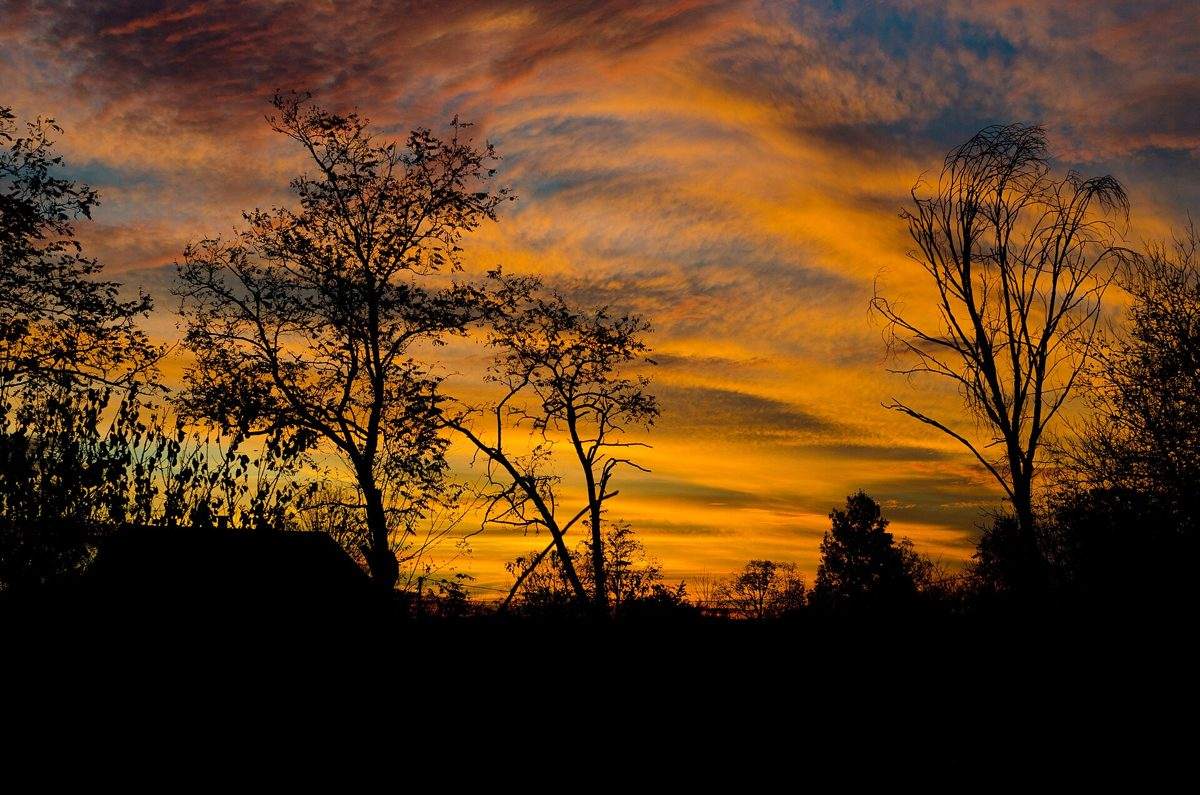
"Red sky at night, shepherd's delight; red sky in the morning, shepherd's warning" is one of the few pieces of weather folklore that survives contact with meteorology. In Britain, Europe and most of North America it is right more often than not, and the Met Office says so on its own website. It works because of two facts: sunlight turns red when it passes through a lot of air, and weather in the mid-latitudes moves from west to east.
Why the sky turns red at all
Sunlight is scattered by air molecules and small particles, and blue light scatters far more than red (the effect is called Rayleigh scattering, and it is why the daytime sky is blue). At sunrise and sunset the light travels through many times more atmosphere than at noon, so most of the blue is scattered away before it reaches you, and what is left is orange and red. The colour becomes deeper when the air contains more small particles, dust and aerosols, which is exactly what settled high-pressure air tends to hold: sinking air traps particles near the ground and there is no rain to wash them out.
Why evening red means fair weather
At sunset you are looking west. A vivid red sunset means the air to the west is clear enough to let the sun through and dusty enough to redden it, which is the signature of a high-pressure system. Because mid-latitude weather is carried from west to east by the westerlies, the high to your west is on its way to you. Tomorrow will most likely be dry and settled. The rhyme is a one-day forecast built on the direction of the prevailing wind.
Why morning red means rain
At sunrise you are looking east, and a red sky there means the high-pressure air has already passed over you and is moving away. Whatever follows a high is usually a low, with cloud and rain. A red morning often also means high cloud arriving from the west is being lit from below by the rising sun, and high cloud is the first sign of an approaching front. Hence the warning.
When the rhyme fails
- In the tropics, where the trade winds blow from east to west, the logic reverses and the rhyme is useless.
- When weather is coming from another direction, for example an easterly flow in a British winter, the red sky tells you nothing about tomorrow.
- Pink, not red. A pale pink sunset under a sheet of high cloud is not the same signal as a deep red one through clear, dusty air. The pale version is often the front arriving.
- Smoke and pollution redden the sky regardless of the weather, which is why wildfire seasons produce spectacular sunsets before terrible days.
How good is it as a forecast?
Nobody publishes a hit rate, but the mechanism is sound and forecasters generally accept it as a fair one-day indicator in the mid-latitudes, better than chance and worse than a model. A five-model comparison for your town on our city pages beats it comfortably; what the rhyme has over the model is that it costs nothing and reminds you to look up. For the forecast the rhyme cannot give you, hour-by-hour rain and wind, the models are the tool, and our accuracy scoring shows which one has been right most often where you live.
Other weather sayings, sorted
- "Mackerel sky, not long dry": broadly true. Rippled cirrocumulus often precedes a front by 12 to 24 hours.
- "Ring around the moon, rain soon": often true. A halo is ice-crystal cirrus, again the leading edge of a front.
- "Cows lie down before rain": no evidence beyond coincidence.
- "Rain before seven, fine by eleven": partly true in Britain, where fronts are usually narrow enough to pass in a few hours.